
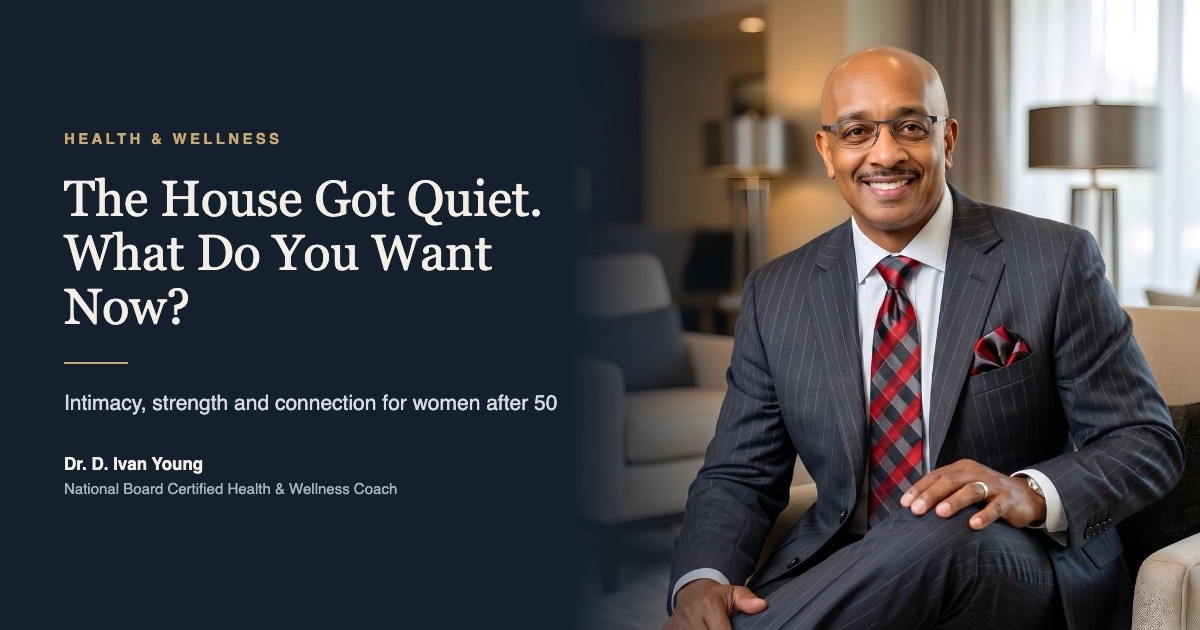
Intimacy after menopause, desire, strength, and the art of wanting something again after 50
ICF Master Certified Coach, EMCC Global Master Practitioner, and National Board Certified Health & Wellness Coach
Picture an empty chair under the hot lights of a daytime television set. Three women sit facing it. The host leans in and asks one question: Who used to sit there?
One says, “My husband. He died three years ago.” Another says, “My daughter. She just left for college.” The third takes a beat. “Me. Before I got so busy taking care of everybody.”
The studio goes still. Then the host asks the question that changes the room. “What would you like to make room for now?”
Now the story gets interesting, because grief and appetite can share a table. A widow can miss her husband and still feel her pulse jump while she picks out earrings for a date. An empty nester can cry the whole drive home from campus, then eat cereal for dinner standing at the counter, answerable to no one. A divorced woman can love having the whole bed to herself and still want someone to reach for her in it. And if what you lost was a friend, or the dog who kept you company through all of it, a quiet kitchen can be enough to undo you.
You can honor what you miss and still make plans for Thursday.
Key takeaways
- Trade “I need to get my life back” for one specific want you can act on this week.
- Desire, arousal, comfort and orgasm are four different parts of sexual function. If sex hurts, say so plainly to your clinician.
- The CDC recommends aerobic, strength and balance activity for adults 65 and older. Start with movement you enjoy enough to repeat.
- Make one standing date with the world: something recurring, with people you’d be glad to see again.
You spent decades reading the room. Now read yourself.
You can read a boardroom in four seconds. You know from the way a colleague closes her laptop whether the deal is still alive. You can hear trouble in your daughter’s “I’m fine” from two time zones away. Turn that same instrument on yourself for a minute.
Ask what the change actually changed. Who do you call now when something ridiculous happens? What used to get you dressed on a Saturday? What were you good at inside that relationship that deserves a bigger stage?
“I need to get my life back” is too heavy to lift before breakfast. “I miss having someone to walk with” fits in your hand. You can call a friend. You can try the walking group. You can find out whether you even like walking with people before you sign up for every Tuesday until spring.
Part of why your own preferences sound faint is that everyone else’s have been so loud. Research discussed in Harvard Business Review found that women leaders faced age-based criticism at different stages of their careers, and the criticisms shifted as the women got older. The target moved. The criticism stayed. So audit the voices. Think about what you’ve absorbed about how a woman your age should dress, date, move, or talk about sex. Which of those rules would you keep if nobody else got a vote?
Then pick one want small enough to act on by Sunday. I want to tell a partner what feels good. I want to travel without wondering whether I can lift my own suitcase into the overhead bin. I want a weekend with people I actually enjoy. Do one thing this week that lets you watch yourself follow through. Confidence is a receipt. You collect it every time you prove you can influence what happens next.
Sex after 50 is a conversation, not a performance review
There is love after 50, after 60, and after 70. And the woman you are now may want things the woman of 35 never thought to ask for. More conversation before anyone’s clothes come off. A hand on the small of your back that arrives without an agenda. Slower. Maybe you’re dating again and realize you never learned the most useful sentence in the bedroom: “I like that. Keep doing it.”
Start by naming what moved. Desire, arousal, comfort, and orgasm are four different parts of sexual function, and it helps to know which one you’re talking about. Your brain also keeps score of last time. If you’ve come to expect pain, of course your body braces when a partner reaches for you. Call that what it is: memory, doing its job. Sleep gets a vote too. When hot flashes have you up half the night, “I’d rather sleep” is real information, and your clinician should hear it. (Source: Harvard Health on sex in midlife and beyond.)
If sex hurts, say so plainly at your appointment. Don’t shrink it into “things feel a little different.” Dryness and discomfort can have treatable causes, and your options depend on your symptoms and medical history. Stanford Medicine also notes that shifts in attention and memory can occur during the menopause transition. If the fog lingers or thickens, tell your clinician when it started, how you’re sleeping, and what else has changed. You can take your body seriously and still enjoy a little flirtation while you sort it out. (Sources: University of Texas Medical Branch on menopause care; NYU Langone on perimenopause treatment.)
Build a body with somewhere to go
You’re allowed to want to look good in that dress. You’re also allowed to want strong legs because you have places to be. Strong legs are a passport. And if you’ve never felt at home in your body, this can be the season you start a relationship with it built on what it lets you do.
Picture the scene. Third song, and you’re still on the dance floor. A city you’ve circled on the map for twenty years, explored on foot. Getting up off the rug after playing with a grandchild, and nobody has to form a committee. What gets you there? A beginner strength class. A walk with a friend. More sleep, and a real lunch instead of whatever was rattling around the bottom of your purse.
The CDC recommends aerobic, strength, and balance activities for adults 65 and older. Build toward that with movement you enjoy enough to repeat. Pair it with meals that include foods such as beans, eggs, fish, vegetables, fruit, and whole grains. If you’re starting from zero, the best first class is the one your friend will walk into with you.
Make one standing date with the world
After a loss, “Let’s get together sometime” can leave you holding a surprisingly empty month. Someday never shows up on a calendar. Try something recurring. A Saturday strength class. Line dancing, where you will turn left while the whole room turns right, and you will laugh about it. Stay for coffee afterward. There’s a decent chance the woman laughing beside you was nervous about walking in alone, too.
Romance can be part of what comes next, whether you date men, women, or decide your own company is the best date in town. So can the friend who remembers your anniversary, the man you’ve never wanted to date but love seeing movies with, and the neighbor who understands why you still miss your dog. Harvard’s long-running study of adult development connects close relationships with well-being. Rice University psychologist Christopher Fagundes discusses ways to cope with loneliness, isolation, and stress. You don’t need a new social life by Friday. You need one person you’d be glad to see again next week.
Some conversations deserve a rehearsal. If you want a private place to think out loud before you make the call, go on the date, or sit down with your physician, URIEL EI, the decision-support platform I founded, can serve as a reflective sounding board. Try asking, “I miss having plans, but I’m nervous about walking into a room alone. Help me choose one thing I’d actually enjoy.” Or, “Help me find the words for what I want to tell my partner about sex.” Then step away from the screen and have the conversation, or put the class on the calendar. If you’d rather work through the decisions and habits of a major transition with a person across the table, that’s the work we do in private coaching.
Measure your life by gauges you actually care about. Are you sleeping well enough to look forward to the morning? Getting stronger? Seeing people who make you laugh? Comfortable asking for the kind of touch you want? Notice that none of those gauges lives on a bathroom scale.
That chair from the opening may always remind you of someone. Leave it where it is. Grief can keep its chair. It doesn’t get the whole house. And on Thursday, put on the good shoes, go dancing, and see who’s there.
Your clinician gets the first call
If something has changed, whether that’s desire, comfort, sleep, energy or memory, your clinician is the first conversation. Walk in with a short list: what changed, when it started, and what you’d like to be different. A clear list gets you a clearer appointment.
If you have a partner, their health belongs in the picture too. My piece on midlife sexual health covers what changes for both of you, and life after divorce picks up where this one leaves off.
Sponsored: How I evaluate supplement quality
This article is a well-vetted paid partnership with Thorne. I am a National Board Certified Health & Wellness Coach, not a physician.
Nothing in this section is a treatment for anything discussed above. For pain, desire, sleep or memory concerns, the first step is your clinician, not a supplement.
Give every supplement a job. Before anything goes in my cart, I want answers to three questions. What’s in it? How does the manufacturer test it? And did the research measure the result I care about? Thorne says its products go through four rounds of testing, from raw materials through finished-product stability. That speaks to quality control. The clinical question depends on the ingredient, the formula, and the people studied.
- If you’re shopping for menopause or sexual wellness support: My dispensary carries Perimenopause Complete and Women’s Libido Boost. Bring the label, and an honest description of what’s bothering you, to your clinician. Wanting more desire and wanting sex to stop hurting are two different concerns. The Menopause Society’s evidence review does not recommend supplements or herbal remedies for treating hot flashes and night sweats.
- If you’re taking a prescribed GLP-1 medication: Thorne’s GLP-1 Support Stack is a supplement bundle. The Berry version contains a multivitamin, amino acids, electrolytes, and a biotic blend. A joint advisory from four professional societies emphasizes adequate nutrition, protein, hydration, and resistance training during GLP-1 treatment for obesity. The advisory didn’t test this bundle. If reduced appetite is making it hard to eat enough, raise that with your prescriber or dietitian before deciding what to add.
- If you’re looking for mental clarity: Memoractiv contains caffeine and several botanicals. I didn’t find clinical evidence that this formula treats menopause-related brain fog. If you’re exhausted, waking repeatedly, or struggling to concentrate, tell your clinician what’s happening before you try to push through with a focus product. If you take metformin and persistent fatigue is part of the picture, ask whether checking vitamin B12 makes sense.
- If you’re working on strength: Creatine monohydrate has a clearer research question behind it. A review of trials in older adults found greater gains in strength and lean tissue, on average, when participants took creatine alongside resistance training. The training is the engine. The trials tested creatine riding along with it. For women reviewing their nutrition or bone health, Women’s Multi 50+ and Vitamin D-1,000 are examples of labels to compare with a clinician against what you already take and what you actually need.
If one of those conversations applies to you, bring the product label to your clinician or pharmacist.
Frequently asked questions
Is it normal for desire to change after 50?
Yes. Desire, arousal, comfort and orgasm are four different parts of sexual function, and any of them can change with menopause, sleep, stress or past experiences of pain. Name which one moved. That gives your clinician something specific to work with.
What should I do if sex hurts after menopause?
Say so plainly at your appointment, and do not shrink it. Dryness and discomfort can have treatable causes, and the right options depend on your symptoms and medical history.
How much exercise do adults 65 and older need?
The CDC recommends a mix of aerobic, muscle-strengthening and balance activities for adults 65 and older. Start with movement you enjoy enough to repeat, and build from there.
Do supplements help hot flashes?
In its 2023 nonhormone therapy position statement, The Menopause Society does not recommend supplements or herbal remedies for treating hot flashes and night sweats. Ask your clinician about treatments that have evidence behind them.
How do I start meeting people again after a loss or divorce?
Choose something recurring over a one-time plan: a weekly class, a walking group or a dance night. Seeing the same people regularly makes friendship easier to build, and romance too, if you want it.

About the Author
Dr. D. Ivan Young
ICF Master Certified Coach · EMCC Global Master Practitioner · National Board Certified Health & Wellness Coach
Dr. D. Ivan Young advises leaders, licensed professionals and couples through the decisions that shape the second half of life: work, health, partnership and what comes next. He is an ICF Master Certified Coach, an EMCC Global Master Practitioner and a National Board Certified Health & Wellness Coach, and a Professional Fellow of the Institute of Coaching at McLean Hospital, a Harvard Medical School affiliate. He is the founder of Young Ethical Intelligence, Inc. and of URIEL EI, a decision-support platform that gives people a private place to think before they decide. He writes on health, intimacy and judgment from midlife onward. He is a Thorne professional partner and is not a physician.
This article is educational and does not provide medical advice. Please consult your clinician before starting a supplement or changing treatment.