Blog

When God Is Silent: How to Find Hope!

Depressed Bi-racial woman with hands folded. When God Is Silent: How to Find Hope

When God Is Silent: How to Find Hope

When God Is Silent: How to Find Hope When You’re Burned Out, Broke, and Barely Holding On

By Dr. D Ivan Young, MCC, NBC-HWC

Why Faith Feels Fragile in Financial Crisis

Have you ever found yourself lying awake at 3:00 AM, heart racing, staring at the ceiling, wondering how you’re going to pay the bills? You’ve prayed. You’ve fasted. You’ve done everything you know how to do—but nothing seems to be moving fast enough.

Which brings us to a question many of us are quietly asking:
“When God Is Silent: How to Find Hope When You’re Burned Out, Broke, and Barely Holding On?”

If you’re being honest, you’re tired—not just in your body, but in your spirit. And in your soul.

If you’re in that space, I see you.
Truth is, I am you.

It’s a hard, humbling place to be. And maybe, like me, you’re there right now—working harder than ever, only to watch your savings drain faster than you can refill them. You’re putting in the hours, grinding, showing up with everything you’ve got… but it still feels like you’re not gaining the traction you need to move forward.

And some days, the hardest part isn’t the struggle itself—
it’s the silence. You’re crying out, pouring your heart out in prayer, and all you get back is… stillness. No breakthrough. No answer. Just waiting.

Yet, even in this valley, something powerful is happening. I’m discovering a new kind of strength—resilience. And it’s coming from places I used to overlook: the friend who shows up when I need it most, or the unexpected opportunity that covers just enough to take another step, the simple breath I can still draw even when the weight of life feels crushing.

So let me be real—this message is as much for me as it is for you. It’s how I’m processing this season, and maybe, it’s how you’ll find comfort in yours too.

If you’ve been up late Googling,
“how to get an answer from God when life gets hard” or
“finding hope in hopeless times,”

let this be your sign, your confirmation: You are not alone. And you are not forsaken.

Let’s tell the truth—spiritual burnout hits hard. So does compassion fatigue, financial pressure, and emotional exhaustion.

I built a thriving coaching practice by guiding high-achievers, executives, and everyday people through life’s toughest storms. I’ve spoken on global stages. My TEDx talks reached millions. But behind the scenes, in the stillness away from the spotlight, I stand here—man, not miracle—hoping, praying, and holding on for better days.

Think about this.
You’re checking every box—handling your business, showing up for others, staying thankful. But deep down, you’re asking, “God… did You forget about me? Do You even see or hear me?”

If that sounds like you, don’t stop reading.
Because the truth is—no, He absolutely has not turned His back on you.

The Story That Still Haunts Me

Purpose Comes With a Price Tag (and It’s Not Just Financial)

Here’s the truth that rarely gets said: purpose will cost you everything.
Not just your money, but your ego.
Beyond just your time, but your comfort.
Not only your faith—but your control. So when God is silent,  we need to know how to find hope!

The fact is we often glamorize success stories without acknowledging the messy, painful, confusing middle. The part where you’re too broke to breathe but too gifted to quit. Where your calling feels more like a curse than a blessing.

But here’s what I’ve come to understand:

Delay is not denial. Silence is not absence. And pain is not punishment.

God Hears But Doesn’t Answer

There’s something I haven’t shared publicly until now—because it still hurts and I’m still struggling to recover from it.

Okay, picture this: just two years ago, life felt pretty solid. Things were clicking along, you know? I felt like I was finally on stable ground. Then, this major investment opportunity came up, and honestly? I felt this incredible pull towards it. It wasn’t just a business idea; in my heart, I truly believed it was something I should do—born out of deep love for my daughter and what genuinely felt like a green light from God.

So, naturally, I went all in. Without hesitation I proceeded pouring out savings, putting my personal credibility on the line, all while dreaming about its success day and night. In my mind’s eye, I saw myself building something meaningful, something that would empower my daughter and maybe, just maybe, provide a little financial breathing room down the road. It felt big, like legacy work—weaving purpose and family together.

But here’s where the smooth sailing hit rough waters. That dream, that vision I was so sure of? It just… didn’t pan out. Instead of soaring, the business basically crashed and burned. The money I’d invested? It vanished, like smoke through my fingers. And suddenly, there I was, left holding this enormous weight.

And this… this is the part that’s nearly impossible to put into words.

I didn’t move recklessly. I moved from love. From faith. From a place of deep conviction that what I was doing was good, even godly. I believed I was answering a divine call—doing something noble, building something meaningful. But now? Those same good intentions feel like the very thing dragging me under.

They feel like the source of this constant, gnawing ache in my stomach—the kind that lingers through the night and wakes me before dawn. There’s a quiet frustration that hums beneath everything I do. And sometimes, when I look back, I wonder if I missed something… if I mistook a cleverly disguised trap for a divine assignment.

What if I was set up? 

What if I was set up? What if the very thing I believed would bless me was bait from the enemy?

That thought… it breaks something inside me.

And spiritually—it’s even harder. Because just when I feel like I’m about to sink for the last time, something small shows up. A sliver of grace. An unexpected check. A kind word. A stranger’s generosity. Just enough to keep my head above water. But never enough to reach the shore. Not even enough to give me a much needed break from the stress.

So while I’m crying out—begging for full rescue, for lasting peace, for the nightmare to finally be over—I keep receiving these breadcrumbs of hope. Little mercies. And I am grateful. But the deeper part of me aches, because those small blessings make the silence around the big prayers feel even louder.

It’s like God is keeping me from drowning… but not quite pulling me in.

And that’s what makes this burden hard to carry. To feel seen—but not saved. Held just enough to keep going—but not enough to rest.

It’s like I’m clinging to a life raft in the middle of a storm, grateful not to have gone under… but desperate to touch solid ground. Desperate to feel the warmth of safety, the stability of peace, the finality of “you made it this mess is finally over.”

If you’ve ever felt like that—adrift, weary, questioning—then know this: you are not alone. I’m there with you. And somehow, even in this heartbreak, though it may not seem like it, we are still being kept.

God does not waste pain.

Meanwhile, the practical reality hits hard—every single month. No matter how much I earn, it still feels like I’m always behind. The debt payments—especially with these outrageous interest rates—pull the money right back out of my account almost as fast as it comes in.

And that kind of constant financial pressure?
It’s not just stressful—it’s gut-wrenching.

Every payment feels like a monthly reminder of the moment I took a leap that didn’t land the way I hoped. If I’m honest, sometimes I wonder… if I hadn’t made that move, maybe life would be at least manageable right now—maybe even comfortable. Constantly asking yourself “What if'” is a tormenting teacher.,

So yes—two years later, I’m still paying the price.
Not just financially…
But emotionally. Spiritually.

Because it’s not just about the money.
It’s the sleepless nights.
It’s not just unpaid bills—it’s those same prayers, over and over again, wrapped in tears.
It’s not just loss—it’s guilt, frustration, shame, and the silent burden of regret that you carry alone.

These days, more than ever, I find myself whispering the question again:
“When God Is Silent: How to Find Hope When You’re Burned Out, Broke, and Barely Holding On?”

Because when you’re the one holding the vision…
You’re also the one left to clean up the pieces when it doesn’t go as planned.

And that regret? That emotional weight?
It can bury you in self-blame.

I know what it’s like to scream into your pillow at night, asking God, “Why would You let me walk into that?”
And worse… I know the pain of realizing, “I did this to myself.”

I know the bitterness of watching everyone else move forward, smiling, thriving—
while you’re still trying to breathe through the weight of it all.

But here’s what else I know:
God does not waste pain. 

God’s Silence Doesn’t Mean God’s Absence

Just because you can’t hear Him doesn’t mean He isn’t working.
Because the doors haven’t opened doesn’t mean they’re locked forever.
And just because your faith is shaking doesn’t mean you’ve failed. Put mildly, “delayed doesn’t mean denied.”

We don’t grow in the spotlight—we grow in the soil.
And when you’re underground—hidden, buried, overlooked—it doesn’t mean you’re dead.
It means you’re being planted.

So while it feels like nothing is happening, trust that everything is happening behind the scenes. God is aligning people, finances, opportunities, and protection in ways you cannot see.

The Emotional Toll of Transition

What to Do When You’ve Run Out of Strength

If you’re Googling “what to do when you’re tired of praying,” this part is for you. There’s no formula for surviving this kind of spiritual fatigue, but there are some practices that can help:

1. Surrender.

Not in defeat, but in trust. Let go of the need to control the outcome. You are not failing—you are being led.

2. Speak honestly.

Tell God how you really feel. He can handle your anger, your fear, your exhaustion. Prayer doesn’t have to be polished—it just has to be real.

3. Stay in motion.

Even if it’s just one step at a time—keep going. Faith isn’t just belief; it’s action. Water your vision, even in drought.

4. Find your people.

Whether it’s a coach, a friend, or your online tribe—don’t suffer in silence. Vulnerability creates connection. And connection saves lives.

(Need a place to start? Read my post on The Power of Emotional Intelligence in Leadership to learn how EQ sustains you when willpower fails.)

5. Rest.

You don’t have to earn your worth by grinding. Sometimes, divine strategy is revealed in stillness.

When You Can’t Sleep—Try This

Here’s a short practice I do when I’m up at night and anxiety tries to take over:

Inhale: “I am safe.”
Exhale: “God is with me.”
Breathe deep: “I am not alone.”
Release: “Help is already on the way.

This small moment of presence is a sacred act of resistance. You’re reminding your body that it’s not in charge—your faith is.

Speak This Over Your Life Right Now

Let me speak this gently over you, just as I’ve been whispering it to my own soul in the stillness of night:

Speak these words aloud if you need to. Write them down. Post them on your mirror. Let them become the rhythm that steadies your breath and strengthens your soul.

You win—provided you don’t quit.

Let your spirit remember what your weary mind may have forgotten:
The fact that you are still in the fight is confirmation that you’ve won this battle. If you need a bit of inspiration watch this TEDx talk I did a couple of years ago. 

Hope Is Not a Feeling—It’s a Choice

You’re Closer Than You Think

Though God may seem silent, He is still present.
When the money runs low, grace overflows.
In moments of emptiness, you are still enough.

Hope isn’t always loud. Honestly, it’s a merely quiet decision to continue believing—one moment, one instant, one step at a time.

I don’t know how or when, but I know this: the shift is coming. Your help is on the way. And the same God who brought you through the last storm is already waiting at the other side of this one.

When you’re tired, take a rest.
In moments of fear, say a prayer.
If pain finds you, let the tears fall.
But no matter what—don’t give up.

Not now. Not this close.

Dr. D Ivan Young, MCC, NBC-HWC

About Dr. D Ivan Young

Dr. D Ivan Young, MCC, NBC-HWC is an internationally acclaimed Master Certified Coach, author, TEDx speaker, and expert in Emotional Intelligence and human behavior. He’s helped thousands of high-achieving individuals—including executives, elected officials, and public figures—find clarity, healing, and purpose through life’s toughest transitions. Learn more about my coaching philosophy on Finding Purpose in the Midst of Pain.


Why “Trump Derangement Syndrome” Is Not Real – Why Black Men Voted for Trump

Black Who Voted for Trump experiencing buyers remorse

"Trump Derangement Syndrome" Is Not a Real Diagnosis

Why Black Men Voted for Trump – Why “Trump Derangement Syndrome” Is Not a Real Diagnosis

By Dr. D Ivan Young, MCC, NBC-HWC

How do you deal with buyer’s remorse about voting for Donald Trump?

As a behavioral neuroscientist, Master Certified Coach (MCC), and National Board Certified Health and Wellness Coach (NBC-HWC), I spend my days guiding high-performing individuals—including many Black men—through the emotional, psychological, and sometimes spiritual complexities of leadership, relationships, and personal growth. So, when a CNN senior producer recently asked me, Why Black Men Voted for Trump? And  Why I believe that “Trump Derangement Syndrome” Is Not Real? I could not pass up the opportunity to weigh in on this sensitive but timely question, and believe me, I leaned all the way in.

Understanding the Psychology Behind the Vote

.

To understand this phenomenon, we need to get under the hood of human behavior. Decisions—especially political ones—are emotional before they’re rational. That’s easily confirmed by neuroscience. People respond to perceived threats, unmet needs, and emotional narratives.

Black men, historically and presently, face immense pressure: economic instability, societal invisibility, and emotional isolation. When someone comes along promising to upend the establishment and restore power to “the forgotten man,” it’s not hard to see why that message lands with Men of Color. When someone tells people what they want to hear and believe, it’s easy to manipulate them from there. But, here’s the rub: true empowerment doesn’t come from chaos, it comes from clarity. Unfortunately, for many that’s learned in hindsight. 

So What Now? Dealing With Voting Remorse

For those experiencing what we might call “political regret,” the first step is to shift from shame to reflection. Shame shuts people down. Reflection opens them up. Buyer’s remorse, when handled properly, is an opportunity for growth. It forces people to ask themselves:

  • What was I hoping for?
  • Did I get it?
  • If not, what can I learn from this experience?

As someone who coaches leaders to navigate high-stakes decisions, I see this kind of regret often. My message? It takes strength to admit a mistake. It takes wisdom to learn from it. When vulnerability meets an opportunist, the opportunist typically wins. 

To the 3 Out of 10 Black Men Under 45 Who Voted for Trump

Though it’s a struggle for me  to understand how so many people ignore the facts, I totally get it.  Frustration clouds good judgement a rational thinking. That’s why “Trump Derangement Syndrome” Is Not a Real Diagnosis.

Like most political campaigns, the Trump organization and Elon Musk spent millions crafting messages tailored to your lived experiences. But these messages weren’t just meant to inform—they were designed to trigger. They tapped into your frustrations, your sense of being overlooked, and the promises that were never kept. Their sole objective? To push you to take one action: cast your vote. And once you did, their job was done.

This is a textbook example of psycho-social manipulation. It’s the same strategy used in ad campaigns that convince you to buy things you don’t need—sometimes even things that are harmful to your physical, mental, or emotional well-being. These tactics bypass your rational thinking and go straight for your primal instincts. They provoke emotion, stir up fear or anger, and overwhelm your ability to think clearly. Even when facts and logic suggest a different path, your emotions win the battle.

They knew exactly how to hit your pain points—where you felt unseen, unheard, or fed up—and then tailored commercials, events, and media content to speak directly to that raw emotion. Put mildly? You got played.

Now, let’s be clear: you are not a faceless, monolithic group. Instead, you are a tapestry of diverse individuals. You are the entrepreneurs building businesses from the ground up, the fathers guiding and protecting their families, the athletes pushing the limits of human potential, the artists expressing the soul of our culture. You are one of the critical thinkers challenging the status quo.

EMOTIONAL REGULATION AND VOTING BEHAVIOR

Furthermore, many of you have grown weary of the political theater, of politicians who deliver speeches at you, rather than engaging in genuine dialogue, listening to your concerns. Moreover, you are understandably skeptical of performative allyship, the empty gestures and hollow promises that consistently fail to materialize into tangible change. In essence, you experienced a sophisticated manipulation, a calculated attempt to exploit your emotional voids for political gain, and that feeling of betrayal is entirely valid.

You voted not just against a party, but against a narrative that never truly reflected your reality. And Trump’s brand—raw, unapologetic, anti-establishment—felt like a middle finger to a system you believe ignored you. I hear that. I respect your agency.

But now it’s time for a deeper reckoning from within. What, precisely, did you get in return? Policies that benefited your communities? Rhetoric that empowered your families? Or were you collateral damage in a strategic political game that never really had you in mind?

And if you’re still on the fence—doubling down on the same choice in hopes of a different result—ask yourself: Am I voting for change, or just reacting to disappointment?

What Do They Think About Their Vote Today?

Some are doubling down, locked into confirmation bias. Others are quietly re-evaluating, especially in light of Trump’s legal troubles, inflammatory rhetoric, and erratic leadership style. What I see most, though, is cognitive dissonance fatigue.

People are tired of justifying decisions that no longer align with their values or lived experience. They’re tired of being called “sellouts” or “sheep” and tired of being pulled into a cultural tug-of-war that often overlooks nuance.

This is the moment for introspection. Not because someone told you you’re wrong, but because growth requires alignment between belief and behavior.

Is “Trump Derangement Syndrome” a Real Diagnosis?

Let’s be clear: “NO”, “Trump Derangement Syndrome” (TDS) is NOT a legitimate clinical diagnosis. It’s a term often used to discredit legitimate logical and emotional reactions to Trump’s impulsive behavior and aberrant policies. According to the American Psychiatric Association, TDS is not listed in the DSM (Diagnostic and Statistical Manual of Mental Disorders).

But while the term itself is flippant, the psychological impact of divisive leadership is real. People are dealing with heightened levels of stress, anxiety, and moral fatigue—especially those in marginalized communities. We’re not dealing with derangement; we’re dealing with collective trauma.

In my work, I help clients develop emotional regulation and cognitive flexibility, two hallmarks of healthy psychological functioning. What’s happening for many isn’t mental illness—it’s the result of navigating a socio-political landscape that often feels like psychological warfare.

Moving Forward: What Black Men (and All Voters) Should Ask Themselves

If you’re unsure where you stand, or if you’re rethinking your choices, here are some reflective questions:

  1. Does my vote reflect my values or just my frustrations?
  2. What do I want for my family, my community, and myself?
  3. Is the candidate I’m supporting aligned with those goals?
  4. Am I making an emotionally reactive decision, or a strategically informed one?

These aren’t just political questions. They’re questions about identity, agency, and integrity. And that’s where the real work begins.

Black men have every right to demand better from the political system. But protest voting, while emotionally satisfying in the moment, often leads to outcomes that don’t serve long-term interests. Change isn’t just about disruption. It’s about direction.

This is why I always say: the same fire that can burn down a house can also illuminate your mind. The question is, what are we fueling?

A Final Word

As someone whose work has been featured on TEDx, CNN, and MSNBC, and as a certified expert in emotional intelligence and evidence-based coaching, I can tell you this: we are at a tipping point. The decisions we make now will shape not just the next election cycle, but the psychological and cultural landscape of the next generation.

Let’s stop talking about votes in terms of red or blue. Instead, talk about alignment, integrity, and emotional maturity. Take the time to talk about what competent ethical leadership actually looks like.

And to every person of color, especially black men, a man or woman who’s feeling misunderstood or misrepresented, know this: you are not invisible. But being seen means being accountable. And being powerful means being informed.

Related Posts on My Blog:

  • The Power of Somatic Observation: What Your Body Knows That Your Mind Doesn’t
  • How Emotional Intelligence Changes Everything in Leadership
Picture of Dr. D Ivan Young, MCC, NBC-HWC | ICF Registered Mentor Coach

About Dr. D Ivan Young
Dr. D Ivan Young is an ICF Master Certified Coach, NBC-HWC board-certified coach, and a renowned behavioral neuroscientist. He is a professional fellow at the Institute of Coaching (Harvard Medical School affiliate), a three-time TEDx speaker with over 4.9 million views, and a sought-after thought leader featured in CNN, FOX, MSNBC, ABC and major media outlets. His coaching practice serves high-net-worth individuals, celebrities, public figures, and executives committed to personal and professional transformation.

For media inquiries or to book Dr. Young, visit www.drdivanyoung.com or contact us at 877-508-2025.

Is God Real? The Search for the Divine.

Is God Real? The Search for the Divine. Man standing in front of Stained Glass praying

Is God Real? The Search for the Divine...

For as long as humanity has existed, we have sought answers to life’s most profound questions: Why are we here? What happens after we die? Is there a higher power governing the universe? While science offers explanations for the physical world, the spiritual realm remains an enigma—one that transcends logic, yet profoundly shapes our experiences.

As someone who has walked through fire—battling cancer, navigating life as an adopted only child, and overcoming adversity—I’ve personally encountered moments that defy coincidence. Prayers answered at the eleventh hour, doors opening when all seemed lost, and an undeniable presence of guidance beyond my own understanding. These experiences lead me to believe that there is, indeed, something greater at work—what I call the Divine. But is God real?

A Universal Belief in the Divine

The concept of God, or a higher power, is not unique to any one religion. Across cultures and centuries, humanity has instinctively turned to the heavens for hope, purpose, and understanding. In Christianity, God is the omniscient Creator; in Islam, Allah is the Most Merciful; in Hinduism, Brahman is the infinite cosmic force; and in Buddhism, while there may not be a personal deity, the pursuit of enlightenment is guided by spiritual forces. Even within indigenous traditions, there is reverence for nature, spirits, and an unseen world.

We are not alone

Despite theological differences, a shared belief emerges: we are not alone. Whether we call upon God, the Universe, Source Energy, or the Divine, there is an inherent human inclination to seek connection with something beyond ourselves.

Scientific studies even suggest that spirituality positively impacts human well-being. Research from Koenig et al. (2012) in The Handbook of Religion and Health highlights that individuals with strong spiritual beliefs tend to experience lower levels of stress and higher rates of resilience. Another study published in Psychological Science (Norenzayan & Shariff, 2008) found that belief in a higher power can foster cooperative behavior and moral decision-making, suggesting an evolutionary benefit to faith. Similarly, research from Harvard Medical School (Rosmarin et al., 2011) suggests that belief in divine guidance, including the presence of angels or spiritual guides, can lead to improved mental health outcomes and emotional resilience.

My Journey: Answered Prayers and Divine Intervention

Faith isn’t about having all the answers—it’s about trusting in something greater, even when the path is unclear. I’ve experienced this trust firsthand. As a cancer survivor, there were moments when I felt utterly powerless. Yet, in my most vulnerable state, I witnessed an undeniable truth: the Divine shows up, often in unexpected ways.

There have been countless times when I prayed for financial provision, for a way to keep my practice afloat, or for resources I had no idea where to find. I remember nights when I couldn’t see a way forward—when bank accounts were empty, and every logical avenue was exhausted. But within 48 hours of each of those prayers, something miraculous happened. A call, an unexpected opportunity, or a new door would open. That is not coincidence; that is Divine timing.

One of the most profound examples of this occurred when I was at a financial low point. My business was at a standstill, bills were piling up, and I had nowhere else to turn. I prayed fervently, asking God to make a way. Within two days, I received an unexpected business opportunity that not only covered my expenses but also led to long-term financial stability. Time and time again, I have witnessed the Divine respond in moments when logic suggested no way forward.

The Role of Faith Beyond Religion

Faith is often associated with religious doctrine, but belief in the Divine doesn’t require adherence to organized religion. Many people struggle with faith because they equate it with institutions rather than relationship. But God—or whatever name one chooses for the Divine—is not confined to a church, mosque, or temple.

Faith is the quiet reassurance that we are guided. It’s the inexplicable peace that comes when circumstances say we should be afraid. It’s the unseen hand that orchestrates moments too precise to be mere chance. And faith, at its core, is deeply personal.

This is why, when people ask, “Is God real?” my response is not to prove or disprove, but rather to invite reflection: Have you ever experienced something that logic alone couldn’t explain? Have you ever received exactly what you needed, right when you needed it? If so, perhaps you’ve already encountered the Divine.

The Presence of Angels and Divine Messengers

Across religions, the presence of angels or divine messengers is a recurring theme. In Christianity and Islam, angels serve as God’s messengers, guiding and protecting humanity. In Judaism, angels intervene in critical moments, and in Hinduism, celestial beings oversee cosmic order. Even in non-religious spirituality, the idea of guardian spirits or universal energy providing direction is prevalent.

Many people, including myself, have had experiences where they were guided toward the right people, opportunities, or solutions without knowing how or why. I recall times when I was about to make a decision that would have led to disaster, only for an unexpected encounter or sudden clarity to steer me in another direction. Those moments, I believe, are not just intuition—they are divine interventions.

Trusting the Divine: A Call to Open-Mindedness

The question of God’s existence is one that each person must answer for themselves. But one thing is certain—whether we believe or not, life has a way of reminding us that we are not in control. There is an order to the universe that defies randomness. There are moments of grace that logic can’t fully explain. And there is a presence that speaks—not always in an audible voice, but in ways our hearts recognize.

So, is God real? I invite you to reflect, not with skepticism, but with curiosity. Look back on your life. Consider the times you’ve been saved from what could have been disaster. Think about the people who’ve come into your life at precisely the right moment. Perhaps faith isn’t about certainty, but about acknowledging that some things are too extraordinary to be mere chance.

In the end, belief in God—or the Divine—is less about finding empirical proof and more about experiencing an undeniable presence. For me, the answer is clear: God is real. And whether we see it immediately or in hindsight, Divine love, guidance, and timing are always at work.

Final Thoughts: A Journey, Not a Destination

.

Spirituality isn’t about having all the answers. It’s about being open to the journey. No matter your background, beliefs, or doubts, the Divine remains present—patiently waiting for you to recognize its hand in your life.

So, if you’re searching, questioning, or simply wondering, I encourage you to stay open. Talk to God, the Universe, or whatever name resonates with you. Ask for clarity. And then, pay attention.

Because sometimes, the greatest evidence of God’s presence is not in the miraculous—but in the moments we once called coincidence and now recognize as Divine.

Dr. D Ivan Young, MCC, NBC-HWC

Dr. D Ivan Young is an expert on human behavior and relationships. He’s a Master Credentialed expert on personality type, an ICF  Master Certified Coach, a Certified Positive Intelligence Coach, and a National Board Certified Health and Wellness Coach. Dr. Young is also a member of the prestigious Forbes Coaches Council and a Fellow at the Institute of Coaching an affiliate of the Harvard Medical School. For more information visit https://drdivanyoung.com

How to Navigate Loneliness, Burnout, and Depression

Lonely Depressed woman with hands in prayer position.

How to Navigate Loneliness, Burnout, and Depression

Understanding the Loneliness Epidemic

Have you ever felt like you’re drowning in responsibilities, struggling to keep your head above water? Or perhaps life feels like a treadmill—constant motion but no real progress? Regardless, if so, you’re not alone.

In fact, the loneliness epidemic is a growing crisis affecting millions worldwide. Particularly, with demanding work schedules, digital isolation, and increasing societal pressures, many people experience burnout, stress, and depression. Still, here’s the truth: You are not broken. Additionally, you are not weak. Instead, you are simply carrying too much, and ultimately, it’s time to release the weight.

Why Everything Feels So Overwhelming

The world is changing fast. Economic instability, rising costs, and job uncertainty create constant stress. Social injustice, discrimination, and political division add to the pressure, making many feel unseen and unheard.

On top of this, personal struggles make life even harder. Maybe you’re juggling family obligations while barely holding yourself together. Perhaps you’ve poured yourself into a relationship that left you disappointed or heartbroken. Or, despite years of hard work, you still feel stuck in your career.

The Truth About Loneliness

When life becomes an endless cycle of giving without receiving, exhaustion is inevitable!

Loneliness isn’t just about being alone. You can be in a room full of people and still feel completely isolated. It’s about lacking deep, meaningful connections. It’s about reaching out and feeling like no one is truly there.

The Science of Loneliness

Research confirms this. A study published in the CDC found that prolonged loneliness increases stress, leading to anxiety and depression. (Read the study here). Additionally, the American Psychological Association highlights how chronic stress and emotional exhaustion impact mental well-being. (Read the APA article).

The Impact of Chronic Stress and Emotional Fatigue

In fact, when stress and loneliness persist, they create a cycle of emotional exhaustion. Consequently, your mind and body become overwhelmed, making even small tasks feel insurmountable. For instance, you may struggle to concentrate, experience mood swings, or lose motivation for things you once enjoyed. Eventually, over time, burnout can set in, leaving you mentally drained and physically exhausted.

Furthermore, chronic stress weakens the immune system, thereby increasing vulnerability to illness. Additionally, it also affects sleep patterns, making restful sleep difficult to achieve. As a result, this ongoing cycle can lead to irritability, anxiety, and, in severe cases, depression. Therefore, recognizing these signs early can help you take steps to break free from this harmful loop.

Why You Feel Stuck (And Why It’s Not Your Fault)

High-achievers, caregivers, and entrepreneurs often carry an invisible burden. Society expects you to be strong, resilient, and always “on.” But few recognize the toll it takes.

This is even harder for people facing systemic challenges. Many individuals from marginalized communities feel they must work twice as hard for half the recognition. The emotional exhaustion from proving yourself repeatedly can be overwhelming.

And if you’re struggling with relationships, it compounds the problem. Maybe you’re giving everything to someone who isn’t reciprocating. Maybe you’ve been hurt too many times to believe in love. Or maybe you’ve reached a point where you wonder if real connection is even possible.

None of this means something is wrong with you. It means you need support.

How Social Media Contributes to the Loneliness Epidemic

We live in a hyper-connected digital age, yet loneliness is at an all-time high. Social media, meant to bridge gaps, often deepens them instead. Scrolling through curated highlights of others’ lives can make you feel like you’re falling behind, leading to feelings of inadequacy and social isolation.

Studies show that excessive social media use increases anxiety and depression. Instead of fostering real connection, it often promotes comparison, making loneliness feel even more pronounced. If social media is triggering these feelings, consider setting boundaries—limit your screen time and focus on nurturing real-world relationships.

How to Start Healing

If you’ve been waiting for permission to slow down, breathe, and prioritize yourself—this is it. Here’s what you need, not just to survive, but to regain energy and joy:

  • Rest, not just sleep. True rest means unplugging, setting boundaries, and prioritizing peace over productivity.
  • Connection, not just company. Surround yourself with people who genuinely care. If you don’t have them yet, it’s time to seek them out.
  • Permission to feel. Suppressing emotions deepens wounds. Acknowledge your sadness, frustration, and exhaustion without shame.
  • A reset, not a resignation. You don’t have to walk away from everything. You just need a better path forward.
  • Self-compassion. Treat yourself with the kindness you offer others. You are doing the best you can with what you have.

8 Practical Steps to Rebuild Connection

  1. Engage in Meaningful Conversations. Take time to talk with people who truly listen. Even a simple phone call with a trusted friend can help reduce feelings of isolation.
  2. Join a Support Group or Community. Whether online or in-person, surrounding yourself with like-minded individuals who understand your struggles can be life-changing.
  3. Consider Professional Support. Therapy or coaching can provide guidance tailored to your unique challenges. Having someone help you navigate these emotions can make a world of difference.
  4. Take Breaks from Social Media. Step away from the endless stream of curated perfection and give yourself permission to disconnect. Instead of scrolling, engage in real-life interactions that foster meaningful connection. Limiting social media can help reset your perspective and reduce feelings of inadequacy.
  5. Practice Gratitude. Start or end your day by writing down three things you’re grateful for—whether it’s a kind gesture, a small success, or simply the warmth of the sun on your face. Shifting focus to appreciation helps rewire your brain for positivity and resilience.
  6. Engage in Physical Activity. Move your body in ways that feel good to you—whether it’s a brisk walk, yoga, or dancing to your favorite song. Exercise releases endorphins, which naturally boost mood and reduce stress, helping you feel more energized and balanced.
  7. Spend Time in Nature. Step outside and take in the world around you. The rhythmic sound of waves, the rustling of leaves, or even a simple walk in the park can have a profound calming effect. Studies show that spending time in nature reduces cortisol levels and enhances overall well-being.
  8. Set Small, Achievable Goals. Break larger tasks into smaller, manageable steps. Completing even minor accomplishments can restore a sense of control and motivation, making overwhelming situations feel more achievable.

You Are Not Alone

Healing doesn’t happen in isolation. Support, guidance, and proven strategies make a difference.

This is why I do what I do. As a behavioral neuroscientist and ICF Master Certified Coach, I help people move from burnout and loneliness to empowerment. I’ve worked with professionals, entrepreneurs, and individuals who felt lost—guiding them back to clarity, confidence, and connection.

If this resonates with you, take the next step toward change. If you’re looking for more insight, check out my blog on How to Keep Going and Move from Hopeless to Full of Hope. If relationships are your struggle, my article True Happiness Comes After You Learn to Love Yourself explores why connection feels elusive—and how you can change that.

You are not alone. “You’re are stronger than you think.”

About the Author

Picture of Dr. D Ivan Young, MCC, NBC-HWC | ICF Registered Mentor Coach

Dr. D Ivan Young, MCC, NBC-HWC, is a highly sought, globally renowned expert in behavioral neuroscience and Master Certified Coach (ICF), and National Board Certified Health and Wellness Coach specializing in evidence-based coaching methods for high-achieving individuals. To learn more, visit drdivanyoung.com.

Navigating the Darkness: What to Do When Feeling Hopeless

Navigating the Darkness: What to Do When Feeling Hopeless

Ever felt like you’re stuck in a dark pit, with no way out? That’s what hopelessness can feel like. However, it’s not just sadness or a passing disappointment. It’s that heavy feeling deep down that things will never get better, that you’re powerless to change anything. Indeed, life can throw a lot our way: stress that just won’t quit, trauma, loss, health problems, or even the pressure to live up to society’s expectations. Ultimately, figuring out what’s fueling your hopelessness is the first step toward taking control of your life and your mental health. In essence, it’s like finding the key to unlock that mental prison door and start taking back control of your life.

Understanding the Nature of Hopelessness

Hopelessness isn’t simply sadness or disappointment. It’s a deep-seated belief that positive change is impossible. It can stem from various sources: prolonged stress, trauma, loss, chronic illness, or even societal pressures. Discovering the source of your hopelessness is the crucial first step toward reclaiming your sense of agency and empowerment.

“I know this feeling deeply, because I’ve walked through it myself. Indeed, my own journey included facing a cancer diagnosis, and that experience, like a sudden storm, threw me into a whirlwind of fear and doubt. And yet, what I’ve realized is that the feeling of hopelessness goes beyond any single problem, beyond any one diagnosis. It’s that universal echo of “Why me?”, that sense of the future blurring into an unclear and frightening landscape—these are experiences that many, many people share. There were times, I won’t lie, when I felt completely overwhelmed, as if the weight of the world was pressing down, and hope seemed to have vanished entirely. However, even then, in those moments of profound darkness, I discovered that hope, though it might appear small and fragile, can indeed grow. And in that growth, I found that being kind to yourself, showing yourself genuine compassion, truly makes a difference. It’s a lifeline, a steady hand, when you’re navigating those incredibly tough times, no matter what specific challenges you’re facing.”

10 Practical Steps to Take When Hopelessness Strikes (Lessons From My Journey)

    1. Acknowledge your feelings. Don’t dismiss them. Don’t minimize them. Instead, allow yourself to truly feel them. Don’t judge yourself for the emotions that surface. In fact, during my own cancer journey, this was a crucial lesson for me. I had to learn to sit with the fear and the uncertainty. I had to acknowledge the pain, but not let it become my whole identity. And that’s the key: acknowledging your pain isn’t weakness, it’s actually a vital step towards healing.

    2. Break things down. When hopelessness takes hold, even small tasks can feel impossible. So, instead of getting overwhelmed by the big picture, focus on smaller steps. Break your day down into manageable pieces. For example, during my treatment, just getting out of bed felt enormous. That’s why I learned to celebrate every small victory, no matter how tiny it seemed.

    3. Reach out. Isolation makes hopelessness so much worse. Therefore, connect with people you trust. Talk to friends, family, or find a support group. Personally, sharing my struggles with loved ones and connecting with others in the cancer community was essential. Remember this: vulnerability is not weakness, it’s a source of strength. Sharing your struggles can actually make you stronger.

    4. Be kind to yourself. Treat yourself with the same compassion you’d offer a friend going through a hard time. Silence that inner critic. Cultivate a gentle inner voice. In my own recovery, this was a big one. I had to learn to be patient with myself, to forgive my body for what it had been through.

    5. Try mindfulness. Techniques like prayer, meditation and deep breathing can help. They ground you in the present moment. They can quiet the storm of negative thoughts. Even a few minutes can make a difference. I know that during those long hospital stays, prayer and mindfulness helped me stay present, have hope while better managing my stress and anxiety.

    6. Challenge negative thoughts. Hopelessness often comes from distorted thinking. So, question those negative thoughts. Are they based on facts or just assumptions? Look for evidence that contradicts them. For instance, I had to actively challenge the idea that my diagnosis was a death sentence. Instead, I focused on my inner strength and resilience.

    7. Find small moments of positivity. Even little acts of kindness or gratitude can shift your perspective. Volunteer your time. Express appreciation to someone. Or simply take a moment to notice the beauty around you. These small actions can create a ripple effect. For me, finding moments of joy, even in the midst of challenges, became a daily practice.

    8. Take care of your body. Physical and mental health are deeply connected. So, make sure you’re getting enough sleep, eating nutritious food, and getting some exercise. Even a short walk can lift your mood and give you energy. I found that prioritizing my physical health was crucial during and after treatment.

    9. Seek professional help. Sometimes, hopelessness needs professional support. A therapist or coach can give you tools and strategies to navigate your challenges. They can help you build a more resilient mindset. Also, consider resources like the National Alliance on Mental Illness (NAMI). They offer valuable information and support. (External Link: nami.org)

    10. Reconnect with your purpose. Hopelessness can make you lose sight of what matters. So, take some time to reflect. What brings you joy? What gives your life meaning? Reconnecting with your values and passions can reignite your sense of direction. In my own life, my cancer experience actually deepened my commitment to helping others. It led me to share the lessons I learned about resilience and hope.

Finding Your Path Forward (And Helping Others Find Theirs)

Navigating hopelessness is a journey, not a destination. It requires patience, self-compassion, and a willingness to seek support. While these strategies can provide a foundation for healing, sometimes, a more personalized approach is necessary.

If you find yourself struggling to implement these strategies or if your feelings of hopelessness persist, consider seeking guidance from a qualified professional. A coach, for example, can provide personalized support, help you identify limiting beliefs, and develop actionable strategies to overcome challenges.

As a specialist in emotional intelligence and personal development, and as someone who has walked the difficult path of battling cancer, I’ve dedicated my career to empowering individuals to navigate life’s complexities and cultivate inner resilience. Through personalized coaching, I can help you:

  • Identify the root causes of your hopelessness.
  • Develop practical tools to manage negative thoughts and emotions.
  • Reclaim your sense of purpose and direction, even after life-altering events.
  • Build a more fulfilling and meaningful life.

To explore how I can support you on your journey, visit my website Dr. D Ivan Young, MCC, NBC-HWC. You can also find more insights on overcoming adversity by reading my blog post, What to Do When You Feel like Quitting: Is Giving Up Really the Answer?.

Remember, you have the power to transform your experience. By taking proactive steps and seeking support, you can break free from the grip of hopelessness and rediscover your inner strength.

To further understand how emotional intelligence can help in times of stress, explore this article on Identifying signs of anxiety and depression. Also, consider reading about building resilience through self-awareness. For additional mental health resources, please look at the National Institute of Mental Health (NIMH) (External Link: nimh.nih.gov).

Don’t let hopelessness define your story. Reach out, and let’s work together to create a brighter future, just as I did.

The Evolution of Coaching Education

Looking Ahead – The Evolution of Coaching Education

Dr. D Ivan Young lecturing on The Evolution of Coaching Education

Coaching has rapidly evolved from an informal practice into a recognized profession that influences executive leadership, personal development, and organizational performance. But with its rising popularity comes a pressing challenge: ensuring coaching remains credible, ethical, and effective. To be part of the Evolution of Coaching rigorous training is more critical than ever.

As someone who has dedicated years to mastering evidence-based coaching methodologies, I’m passionate about raising industry standards and ensuring that coaching remains a structured, research-backed profession. I’ve seen firsthand how high-quality coaching transforms lives and careers—and I’ve also seen the consequences when coaching lacks proper training and ethical oversight.

That’s why my upcoming conversation with Anna Tavis, Ph.D., Chair of the Human Capital Management Department at NYU’s School of Professional Studies, is both timely and necessary. We share a deep commitment to coaching excellence, ethical practice, and professional accountability. As coaching continues to gain traction in corporate, healthcare, and high-performance industries, ensuring coaches meet rigorous standards is no longer optional—it’s essential..

Why Rigorous Coach Training is More Critical Than Ever

The increasing presence of coaching in executive leadership, healthcare, and organizational development underscores the necessity for professionalization within the field. However, as demand rises, so does the risk of dilution—where individuals with minimal training position themselves as experts. This makes structured, accredited education more critical than ever.

Key reasons for prioritizing rigorous training include:

1. Protecting the Integrity of Coaching

Professional credentials from organizations like ICF and NBHWC serve as a benchmark for coaching excellence.

These certifications are not just honorary titles—they reflect a coach’s depth of training, adherence to ethical standards, and ability to apply evidence-based coaching techniques effectively.

Certified coaches must meet rigorous requirements, including:

Operating Within a Clear Ethical Framework – Ethical coaching isn’t just about good intentions; it’s about adhering to established professional guidelines that protect clients and maintain the integrity of the profession. Certified coaches are trained to recognize boundaries, confidentiality concerns, and power dynamics that arise in coaching relationships.

Applying Scientific, Research-Backed Methodologies – Coaching is more than offering motivational advice. A well-trained coach integrates behavioral neuroscience, positive psychology, and cognitive-behavioral strategies to help clients achieve measurable outcomes. These approaches ensure that coaching interventions are effective, sustainable, and grounded in real science—not just intuition.

Upholding High Professional Standards – Organizations, businesses, and high-net-worth individuals are increasingly seeking coaches who demonstrate professionalism, accountability, and ongoing development. To maintain certification, credentialed coaches must engage in continuous learning, supervision, and ethical reviews, ensuring they stay at the forefront of industry advancements.

These standards don’t just benefit the coaches themselves—they also protect clients, corporations, and institutions that invest in coaching as a means of leadership and performance development. Without proper oversight, coaching could devolve into a field where personal opinions and subjective experiences replace structured methodologies and best practices.

2. Coaching Aligning with Organizational and Institutional Standards

More than ever, companies and organizations are investing in coaching to develop leaders, improve workplace culture, and drive performance. But they’re not looking for generic motivational coaches—they want data-driven, results-oriented professionals who can align coaching with business objectives.

This is where accreditation and specialized training make all the difference. Leaders like Michael “Dr. Woody” Woodward, PhD have successfully brought coaching into organizations like BetterUp, ensuring that coaching programs are rooted in behavioral science and leadership psychology. Companies investing in coaching expect measurable results, and properly trained coaches deliver on that expectation.

But coaching isn’t just about meeting corporate demands—it’s about advancing the field itself.

3. Elevating Coaching: The Need for Science-Backed Methodologies

For coaching to earn its place alongside psychology, business consulting, and leadership development, it must be built on scientific principles, structured methodologies, and measurable outcomes.

In today’s results-driven world, coaching can no longer rely on intuition or personal experience alone. It must evolve into a recognized profession that applies evidence-based techniques and ethical guidelines to ensure consistent, high-quality results. This shift is critical for coaches seeking credibility and organizations using coaching as a strategic tool for leadership and performance.

Integrating Science and Strategy into Coaching Excellence

To be truly effective, coaching must incorporate research-backed disciplines that enhance human behavior, leadership skills, and cognitive performance. Three key pillars ensure coaching remains impactful and sustainable:

1. Behavioral Neuroscience & Leadership Science

Understanding how the brain processes information, handles stress, and makes decisions is key to helping clients optimize leadership, productivity, and emotional intelligence. A science-driven approach allows coaches to:

  • Address cognitive biases that influence decision-making.
  • Strengthen executive function skills like focus, strategy, and problem-solving.
  • Support neuroplasticity, helping clients build lasting success habits.

By integrating neuroscience and leadership science, coaches offer practical, evidence-based strategies that improve performance and resilience.

“As leadership evolves, applying neuroscience in coaching will separate top-tier professionals from the rest.” Dr. D Ivan Young, MCC, NBC-HWC

2. Positive Psychology & Mindfulness-Based Coaching

Success isn’t just about skills—it’s also about mental resilience and emotional intelligence. Positive psychology and mindfulness-based coaching help clients:

  • Develop resilience to manage stress and uncertainty.
  • Enhance self-awareness, recognizing strengths and growth areas.
  • Strengthen emotional intelligence, improving leadership and team dynamics.

By integrating these principles, coaches help clients maintain balance, avoid burnout, and sustain high performance.

With increasing workplace demands, mindfulness and positive psychology ensure clients thrive—not just survive.

3. ICF Core Competencies & Applied Coaching Strategies

The International Coaching Federation (ICF) sets global coaching standards, ensuring professional, ethical, and structured engagements. Coaches aligned with ICF principles:

  • Maintain ethical and client-centered practices.
  • Use structured, goal-driven coaching for measurable results.
  • Apply strategies relevant to real-world leadership and business challenges.

By adhering to ICF standards, coaches elevate their credibility and contribute to the profession’s growth.

As coaching advances, alignment with recognized standards will define its future.

Shaping the Future of Leadership and Professional Development

Well-trained coaches do more than help individuals—they shape leadership, business performance, and workplace culture. The industry must continue integrating science, psychology, and leadership research to ensure coaching remains an essential tool for innovation and success.

Coaching is no longer just personal development; it’s a critical business asset that fosters resilience, strategic thinking, and leadership excellence. By embedding scientific principles and structured methodologies, coaching will stand alongside psychology and consulting as an indispensable force in professional and organizational growth.

Where Coaching Education Needs to Go Next

As coaching becomes a key component of executive development, healthcare, and corporate strategy, academic institutions must step up to ensure training programs are rigorous, interdisciplinary, and rooted in science.

Key areas that must be prioritized in coaching education:

  • Balancing theory with practical application – Coaches need real-world experience, not just classroom learning.
  • Integrating behavioral science, neuroscience, and leadership psychology – Coaching should be evidence-based, not opinion-based.
  • Maintaining ethical standards and best practices – Coaches should be held to the same professional standards as other trusted advisors.

This is why organizations like the ICF and NBHWC are leading the charge in setting global standards for coaching education.So, where does this leave us? The demand for coaching is growing, but the standards for coaching must grow with it.

Having spent years coaching high-achieving professionals and organizations, I know that the best results come from deep expertise, a strong ethical foundation, and a commitment to ongoing learning. Coaching isn’t about quick fixes—it’s about long-term transformation.

I’ve seen how rigorous training makes a difference, and I’m committed to pushing the profession forward. My conversation with Dr. Anna Tavis at NYU is just one piece of this larger movement toward higher coaching standards.

  • For coaching to remain a powerful tool for leadership and performance, we must continue raising the bar. That means:
    Prioritizing education over shortcuts
  • Ensuring coaches meet corporate and institutional standards
  • Making coaching a respected, research-backed discipline

Let’s Keep the Conversation Going


Coaching is at a turning point, and now is the time to ensure that it remains a structured, evidence-based profession.

Upcoming Events – NYU

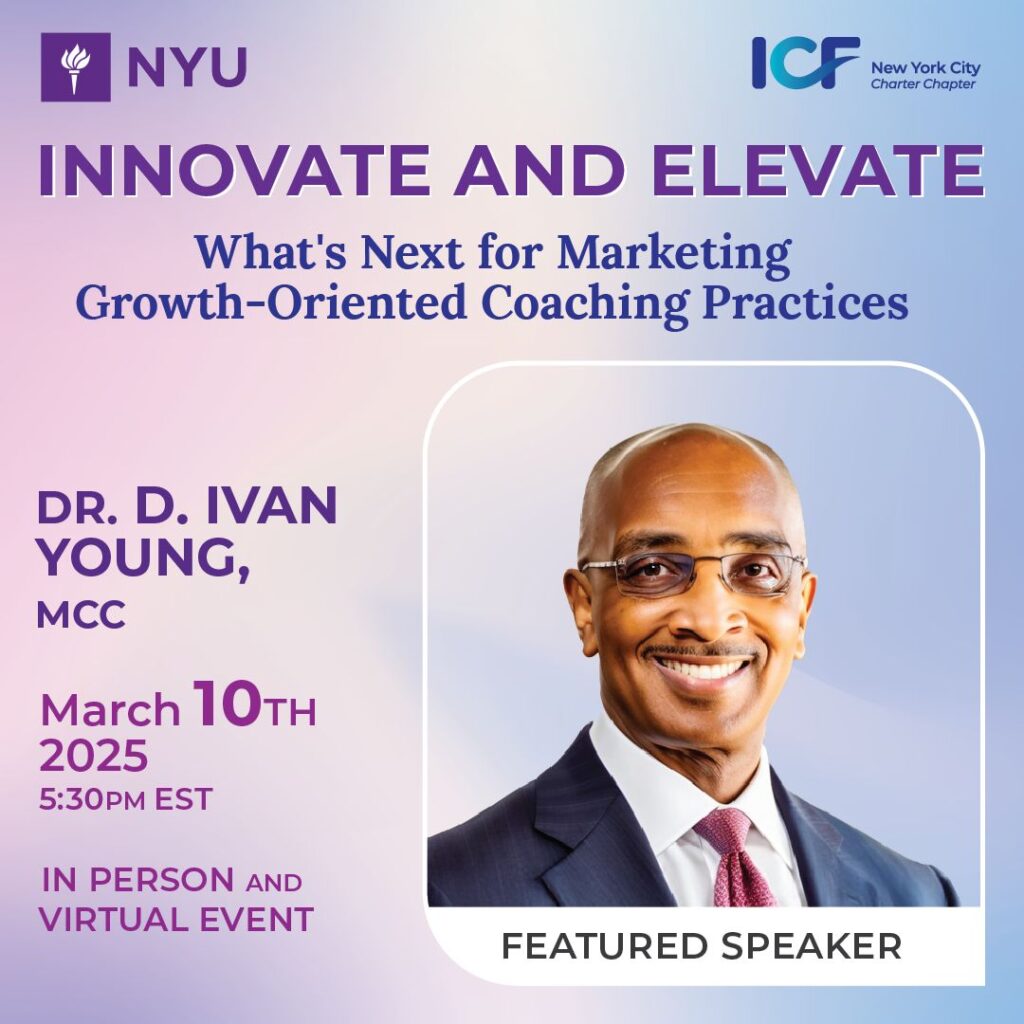
Join us for Innovate and Elevate: What’s Next for Marketing Growth-Oriented Coaching Practices on Monday, March 10, 2025, at 5:30 PM EDT—a hybrid event at NYU in NYC and on Zoom, hosted by ICF NYC and NYU SPS.


📍 Connect on LinkedIn: Dr. D Ivan Young
📍 ICF Credentialing Exam Prep Course: Learn More

The conversation is just beginning—let’s work together to ensure coaching continues evolving in the right direction.

Dr. D Ivan Young, MCC, is a recognized expert in behavioral neuroscience and executive relationship coaching, working with high-net-worth individuals, licensed professionals, public figures, and entrepreneurs. With over two decades of experience in behavioral psychology and executive development, A three-time TEDx speaker with over 4.5 million views, Dr. Young has contributed to discussions on CNN, ABC, MSNBC, CBS, Essence, and Forbes, offering insights on human behavior, leadership, and personal transformation. His approach combines evidence-based coaching, neuroscience, and objective assessments to support lasting change.

Dr. D Ivan Young, MCC in white lab jacket - The Evolution of Coaching Education

The Future of Coaching – Strategies for Success in 2025

The Future of Coaching: Key Industry Trends

The coaching industry is undergoing rapid transformation, and those who adapt will thrive. As an industry leader, I’ve witnessed firsthand how the business of coaching is evolving. On March 10th, 2025, I will be sharing key insights at NYU’s Coaching Business Development Conference. My focus is on helping coaches navigate this ever-changing landscape and build a sustainable, profitable practice.  To be part of the future of the coaching business development strategies for success in 2025 is a critical element. 

Challenges Coaches Face in Scaling Their Business

The demand for professional coaching is stronger than ever. As a result, organizations and individuals increasingly recognize that coaching drives personal and professional success. Nevertheless, with rising competition, shifting client expectations, and evolving digital trends, coaches must be more strategic in how they position themselves and grow their businesses.

Coaches can no longer rely on word-of-mouth referrals alone. In today’s landscape, building a thriving coaching practice requires a data-driven approach, strategic marketing, and scalable business models. Ultimately, those who embrace these changes will define the future of the coaching industry.

Relying solely on one-on-one coaching limits both income and impact. High-performing coaches diversify their revenue through:

  • Online Courses & Memberships – Offering digital programs that generate passive income.
  • Corporate Coaching & Leadership Training – Working with businesses to develop high-performing teams.
  • Speaking Engagements & Masterclasses – Establishing authority while reaching a wider audience.
  • Book Publishing & Thought Leadership – Strengthening brand positioning with long-term visibility.

By incorporating scalable offerings, coaches ensure financial stability and expand their influence.

3. Building Authority Through PR and Media

Visibility matters—now more than ever. Coaches who consistently establish a strong media presence not only attract high-paying clients but also open doors to speaking invitations and lucrative corporate partnerships. In today’s competitive landscape, being seen as an authority in your field is no longer optional—it’s essential.

That’s why investing in strategic PR initiatives, such as guest articles, podcast interviews, and industry conference appearances, is a game-changer. When executed effectively, these efforts not only expand your reach but also position you as a go-to expert in your niche. Moreover, being featured in major publications doesn’t just enhance your credibility—it fosters trust, strengthens your brand, and keeps you top of mind with your target audience. Ultimately, the more visible and credible you are, the greater the opportunities that will come your way.

For more on niche marketing, visit Harvard Business Review or explore strategies from Forbes Coaches Council.

Key Takeaways for My NYU Talk: Elevate Your Coaching Business

1. Personal Branding: The Key to a High-Value Coaching Practice

Your brand is your greatest asset—it’s the foundation of your success. A coaching business is not just a collection of services; rather, it’s an ecosystem built on trust, credibility, and authority. More than anything, your brand shapes how potential clients perceive you and determines whether they see you as an expert or just another option.

That’s why a strong brand must convey confidence, expertise, and consistency. When you take the time to refine your messaging, showcase compelling success stories, and highlight what sets you apart, you don’t just attract attention—you attract premium clients who value your expertise. As a result, you open the door to long-term business opportunities, strategic partnerships, and a reputation that commands respect. Ultimately, the strength of your brand dictates the impact and longevity of your coaching practice.

2. Digital Marketing Strategies for Sustainable Growth

A thriving coaching business requires an intentional marketing strategy. Key digital growth tactics include:

  • SEO Optimization: Ranking high on Google for coaching-related search terms to attract organic traffic.
  • Social Media Engagement: Using LinkedIn, YouTube, and Instagram to connect with potential clients.
  • Speaking & Networking: Leveraging public appearances to build trust and establish credibility.
  • Corporate Partnerships: Aligning with HR leaders, businesses, and institutions for long-term contracts.

Implementing these strategies ensures consistent growth and client acquisition.

3. The Role of AI in Coaching: A Competitive Edge

AI is enhancing coaching practices by providing real-time insights, automation, and personalized learning experiences. Top AI-driven advancements include:

  • Behavioral Insights: AI-powered assessments help coaches identify client patterns more effectively.
  • Automation Tools: Scheduling, client tracking, and communication become more efficient.
  • Customized Learning Paths: AI-driven programs adapt to individual coaching needs, improving outcomes.

Understanding and integrating AI tools will set forward-thinking coaches apart in the evolving industry landscape.

Preparing for the Future of Coaching – Strategies for Success in 2025 

To build a coaching practice that thrives in 2025 and beyond, adaptability is crucial. Success will come to those who:

  • Master niche positioning for a competitive advantage.
  • Develop multiple revenue streams beyond one-on-one coaching.
  • Leverage PR and media to establish thought leadership.
  • Integrate technology to enhance coaching delivery.
  • Commit to ongoing professional development and innovation.

Coaching isn’t just a profession—it’s a powerful movement that transforms lives. As the industry continues to evolve,only those who adapt will thrive. That’s why I’m honored to speak at NYU’s Coaching Business Development Conference, where I’ll be sharing game-changing strategies that not only set high-performing coaching businesses apart but also equip you with the tools to stay ahead.

If you’re truly committed to elevating your coaching practice, then now is the time to take action. These strategies will not only help you navigate the future with confidence but also position you at the forefront of an industry that demands innovation and resilience. Furthermore, as we’ll explore at NYU, the next generation of coaching leaders won’t just follow trends—instead, they will create them, drive change, and leave a lasting impact.

So, the question is: Are you ready to step into that future? If so, let’s build it together.

Dr. D Ivan Young, MCC, is a recognized expert in behavioral neuroscience and executive relationship coaching, working with high-net-worth individuals, licensed professionals, public figures, and entrepreneurs. With over two decades of experience in behavioral psychology and executive development, A three-time TEDx speaker with over 4.5 million views, Dr. Young has contributed to discussions on CNN, ABC, MSNBC, CBS, Essence, and Forbes, offering insights on human behavior, leadership, and personal transformation. His approach combines evidence-based coaching, neuroscience, and objective assessments to support lasting change.

Dr. Young image Future of Coaching Business Development – Strategies for Success in 2025

The Hidden Struggles of High Achievers in Relationships: Why Success Feels Lonely

Why Success Feels Lonely - Woman Struggling with Relationship

Why Do High Achievers Struggle in Relationships?

Why Success Feels Lonely

You’ve built a life most people dream about. The career, the reputation, the financial security—it’s all there. Nevertheless, in your quiet moments, something feels off. In stark contrast, your achievements and your personal relationships don’t reflect the same level of success. You give your best to your work, your business, and your team. But when it comes to love, intimacy, or even meaningful friendships, it feels like you’re constantly navigating landmines.

You’re not alone in this.

High-caliber professionals—doctors, attorneys, executives, public figures, and successful entrepreneurs—face a unique challenge. To sum it up, the very traits that drive success in your career can complicate your personal life. With this in mind, here’s what I consistently hear from my high-achieving clients:

🔹 “Why do I have to carry everything.” People can always rely on you. But when it comes to your emotional needs, you don’t receive that same support in return.

🔹 “People see my success, not my soul.” It’s hard to know who genuinely cares for you versus who benefits from being in your world.

🔹 “I struggle to communicate what I need emotionally.” You’re brilliant at solving complex problems, but when it comes to expressing vulnerability or emotional depth, it’s unfamiliar territory.

🔹 “Because of my responsibilities, I can’t switch off.” Your mind is always running—thinking, planning, solving. Slowing down to connect in a relationship feels like a risk you don’t have time for.

🔹 “Way too often people assume I don’t need anything.” Because you appear strong and capable, those closest to you rarely stop to ask, “How are you really doing?”

🔹 “Love feels like another job.” Managing a business, leading a team, and making critical decisions take so much energy that the idea of maintaining a relationship can feel like just one more responsibility.

🔹 “I don’t trust easily.” Whether due to past betrayals or simply because you’re used to being the one in control, letting someone in can feel more threatening than comforting.

The Pressure of Always Being the One in Control

High achievers often possess qualities like decisiveness, independence, and compartmentalization, which contribute to their success in business. Nevertheless, these traits can sometimes hinder their ability to connect and thrive in their personal lives.

In your career, being in control is a strength. It’s what allows you to anticipate challenges, take action, and stay ahead of the competition. But in relationships? Control can become a defense mechanism that keeps you from fully experiencing an authentic meaningful connection.

But in reality, you’re not avoiding relationships—you’re avoiding vulnerability. And that’s not your fault.

When you’ve spent years (or decades) building a reputation as someone who has it all together, being emotionally open can feel foreign, even risky. Up until now, you may have thought that emotions slow you down. But the truth is, it’s time to recognize that mastering your emotions is the true catalyst for growth—affecting not just your relationships, but every single aspect of your li

The Role of Self-Discovery in Changing Your Relationship Patterns

Here’s something most high achievers overlook:

Your relationship struggles aren’t random.

They stem from deeply ingrained patterns, beliefs, and personality traits that influence how you interact with others. And until you truly understand yourself, those patterns will keep repeating. It doesn’t matter how successful you are in other areas of life.

This is where objective, research-based assessments come in.

Non-biased personality and behavioral assessments—like MBTI (Myers-Briggs Type Indicator), Conflict Mode assessments, and Emotional Intelligence evaluations—offer more than just self-awareness. Put mildly, they give you hard data on why you communicate the way you do. They uncover what you need from a partner.  Most importantly, it can reveal how and why you unconsciously react under stress.

Why Self-Assessment Is a Game-Changer for High Performers

 This removes the guesswork. Instead of wondering why your relationships keep failing or why you feel disconnected, assessments provide concrete answers based on psychological research.

Assessments highlight blind spots. Many high achievers believe they’re great communicators—until they realize their leadership style doesn’t always translate into personal relationships.

They helps you make informed choices. As soon as you understand your natural strengths and weaknesses in relationships, you can intentionally choose partners, friends, and professional dynamics that align with your core personality.

It accelerates change. Traditional self-reflection takes years. A structured assessment process pinpoints the root of your challenges instantly—so you can start making meaningful changes now.

The Benefits of Working with a Coach Who Understands High Performers

Imagine having a space where you don’t have to filter yourself. How beneficial would it be to have a space where you can be vulnerable and process your challenges? Imagine the impact of you developing emotional mastery.

With this in mind, consider the potential of having tools tailored for your life. In a judgment-free zone, you can work without unrealistic expectations. At the same time, avoid ineffective strategies that don’t apply to high-level professionals like you.

Here’s what shifts when you invest in the right guidance:

  • Stronger, Healthier Relationships – Learn how to connect without feeling like you’re giving up your power or independence.
  • Emotional Clarity & Intelligence – Develop the tools to navigate difficult conversations, set boundaries without guilt, and create balance between your personal and professional life.
  • Breaking Free from Self-Sabotage – Identify the subconscious patterns that keep you stuck and replace them with behaviors that create lasting, fulfilling connections.
  • Mastering Work-Life Integration – Build relationships that complement your ambition rather than compete with it.
  • A Relationship Blueprint That Works for You – Understand your unique needs in relationships and attract partners who align with your lifestyle and values.
  • Inner Peace & Personal Fulfillment – Move from constantly managing fires in your personal life to experiencing relationships that nourish and energize you.

Success Without Fulfillment Feels Empty—But It Doesn’t Have to Be That Way

You don’t have to keep struggling in silence.

The same dedication that built your career can be applied to building deep, meaningful relationships—if you have the right tools and support.

It’s time to redefine what success means for you. Real success isn’t just about what you’ve built—it’s about who you get to share it with.

Your Next Step

Take a moment to reflect:
What would it feel like to be fully seen, fully understood, and fully supported—without compromising your ambition?

If you’re ready to move from surviving to thriving in your relationships, it may be time to explore what’s possible when you invest in the right guidance.

Because you deserve more than just professional success—you deserve a life that fulfills you in every way.

Dr. D Ivan Young standing in front of a black Rolls-Royce in a suit and tie.

About Dr. D Ivan Young

Dr. D Ivan Young, MCC, is a recognized expert in behavioral neuroscience and executive relationship coaching, working with high-net-worth individuals, licensed professionals, public figures, and entrepreneurs. With over two decades of experience in behavioral psychology and executive developmentA three-time TEDx speaker with over 4.5 million views, Dr. Young has contributed to discussions on CNN, ABC, MSNBC, CBS, Essence, and Forbes, offering insights on human behavior, leadership, and personal transformation. His approach combines evidence-based coaching, neuroscience, and objective assessments to support lasting change.


Top 5 Mistakes Coaches Make When Submitting ICF Recordings

Coaching candidate avoids the top 5 recording mistakes during the coaching session

Mastering your ICF recordings

By Dr. D Ivan Young, MCC, NBC-HWC, CPDC, Ph.D.

Are you aspiring to earn your ICF PCC or MCC credential? Whether you’re a coaching school graduate, an ACC-level coach seeking advancement, or a professional transitioning into coaching, mastering your ICF recordings is a critical step in the credentialing process. Here are the top 5 mistakes coaches make when submitting ICF recordings. Such preventable mistakes coaches make when submitting their ICF recordings can lead to avoidable resubmissions and delays in earning your ICF certification.

ICF assessors evaluate recordings based on strict adherence to the ICF Core Competencies and Code of Ethics. A well-executed submission demonstrates deep listening, presence, and the ability to facilitate transformative client insights. Let’s explore the top five mistakes coaches make when submitting their ICF recordings—and how to avoid them.

Top 5 Mistakes Coaches Make When Submitting ICF Recordings

Mistake #1: Over-Structuring the Coaching Session

Being inflexible is one of the biggest mistakes coaches make when submitting their ICF recordings. Coaching should be a co-creative process, yet rigid structuring conflicts with key ICF Core Competencies such as:

  • ICF Competency #3 Establishing and Maintaining Agreements – Coaching must evolve based on the client’s real-time needs.
  • ICF Competency #7 Evoking Awareness – Clients need space for self-discovery rather than being led by a predefined coaching framework.

What to Do Instead

  • Start with a flexible agreement and allow organic flow.
  • Follow the client’s lead, not a rigid script.
  • Use powerful, open-ended questions that encourage deeper reflection.

Don’t force an agenda that limits genuine insights.
Avoid leading questions that direct the client to a predetermined outcome.

🔹 Example: If a client introduces an unexpected insight, resist the urge to shift back to your pre-planned structure. Instead, explore what the client is revealing in the moment

Mistake #2: Lack of Demonstrated Active Listening

Here’s another one of the biggest mistakes coaches make when submitting their ICF recordings. Many coaches concentrate more on their next question rather than truly understanding what the client is communicating in the present moment.

Why This Is a Problem

ICF assessors evaluate recordings for:

  • ICF Competency #5: Maintains Presence – The coach must be fully engaged and responsive.
  • ICF Competency #6: Listens Actively – Coaches must capture verbal and non-verbal cues, underlying emotions, and shifts in tone.

What to Do Instead

  • Reflect back and clarify what the client is saying.
  • Acknowledge emotions and underlying meanings.
  • Ask follow-up questions to encourage deeper thinking.

Don’t rush into your next question without fully processing the client’s words.
Avoid surface-level responses that fail to show deep listening.

🔹 Example: Instead of summarizing vaguely, respond in a way that shows true engagement: “You’re feeling stuck. Can you share more about what that means for you?”

Mistake #3: Ineffective Use of Direct Communication

Coaches often struggle with being too vague or too directive, both of which can weaken a coaching session.

Why This Is a Problem

ICF evaluators look for:

  • ICF Competency #8 Facilitates Client Growth – Encouraging insight and accountability without imposing personal views.
  • ICF Competency #4 Cultivates Trust and Safety – Creating a space for clients to process their thoughts while receiving constructive feedback.

What to Do Instead

  • Use simple, clear, and direct language.
  • Ask permission before offering reframes or direct feedback.
  • Challenge limiting beliefs compassionately.

Don’t avoid tough conversations just to keep the session comfortable.
Try not to use complex words or unclear ideas that might confuse your client..

🔹 Example: Instead of saying, “It seems you may have a subconscious aversion to commitment rooted in a potential fear of failure,” say, “Could it be that fear of failure is keeping you from committing?”

Mistake #4: Insufficient Exploration of the Client’s Agenda

Another one of the biggest One of the biggest mistakes coaches make when submitting their ICF recordings is not going deep. Some coaches fail to spend enough time uncovering what truly matters to the client, which weakens the depth of the session.

Why This Is a Problem

  • ICF Competency #2 Embodies a Coaching Mindset – Coaches must be genuinely curious and open to exploring the client’s deeper needs.
  • ICF Competency #3 Establishes and Maintains Agreements – Ensuring alignment with the client’s evolving goals is crucial.

What to Do Instead

  • Ask probing questions to uncover underlying motivations.
  • Clarify what success looks like from the client’s perspective.
  • Revisit the agenda periodically during the session.

Don’t assume the client’s initial response is the full story.
Avoid jumping into problem-solving before fully exploring the issue.

🔹 Example: Instead of asking, “What do you want to talk about today?” try: “What would be the most meaningful takeaway for you from today’s session?”

Mistake #5: Rushing to Action Without Deepening Awareness

Mistake #5: Rushing to Action Without Deepening Awareness

Many coaches focus too quickly on solutions instead of guiding clients through meaningful reflection and insight.

Why This Is a Problem

  • ICF Competency #7 Evokes Awareness – Transformation comes from deep insight, not just quick solutions.
  • ICF Competency #8 Facilitates Client Growth – Clients should take ownership of their next steps.

What to Do Instead

  • Give the client space to process their emotions and thoughts.
  • Use silence strategically to encourage reflection.
  • Help clients connect insights to their larger personal or professional goals.


Don’t rush to problem-solving too soon.
Avoid skipping reflection questions that deepen learning.

🔹 Example: Instead of saying, “What action will you take next?” try: “What insights are standing out to you from today’s session?”

Bringing It All Together

Avoiding the top five mistakes coaches make when submitting their ICF recordings will strengthen your ICF recording submissions, increasing your chances of a successful credential review. Coaching is an art and a science—embracing flexibility, deep listening, and client-driven exploration is key to demonstrating your competency as a professional coach.

If you’re feeling uncertain about your recordings, working with an ICF-registered Mentor Coach or enrolling in a credentialing prep program can provide invaluable support. These resources can help you refine your skills, receive expert feedback, and feel confident in your ability to pass your credentialing exam.

You’ve come this far—don’t stop now! Continue refining your craft and reach out for the guidance that can take you to the next level.

Dr. D. Ivan Young is a globally recognized Master Certified Coach (MCC) with the ICF, a National Board-Certified Health & Wellness Coach (NBC-HWC), an ICF Registered Mentor Coach, and an expert in behavioral neuroscience. With decades of experience coaching high-performing professionals, Dr. Young specializes in evidence-based coaching techniques that help clients and aspiring coaches overcome limitations and achieve transformational results.

Dr. D Ivan Young Speaks on The Future of Coaching Business Development – Strategies for Success in 2025

How to Pass the ICF Credentialing Exam on Your First Attempt

How to Pass the ICF Credentialing Exam on Your First Attempt

Overcoming the Fear of ICF Credentialing: 

Here’s how to Pass the ICF Credentialing Exam on Your First Attempt…

Earning your ICF Professional Certified Coach (PCC) or Master Certified Coach (MCC) credential is a game-changer for your coaching career. Yet, for many coaches, the journey to certification is filled with anxiety, self-doubt, and frustration. You’ve dedicated years to honing your skills, but now you’re faced with the daunting reality of the credentialing process—recorded coaching sessions, strict Core Competency benchmarks, and a challenging Credentialing Exam.

 If you’ve been delaying your application because of fear or uncertainty, you’re not alone. Many coaches second-guess themselves, wondering:

  • What if my coaching session isn’t good enough?

  • What if I fail the Credentialing Exam?

  • What if I invest all this time and still don’t pass?

The truth is that the ICF credentialing process is rigorous, but it is also predictable. With the right preparation, expert guidance, and a structured approach, the end result is that you can dramatically increase your chances of passing on your first attempt. The key? Having a mentor coach who understands the process inside and out, your commitment to making the time to study and adequately prepare yourself, and a prep course that leaves nothing to chance.

The Most Effective ICF Credentialing Exam Prep Course

Why the Right Mentor Coach and Prep Course Matter

Just as aspiring doctors participate in residency programs and future lawyers enroll in bar exam prep courses, PCC and MCC candidates require specialized preparation to successfully pass the ICF Credentialing exam on their first attempt. As a result, many coaches wrongly believe that general coaching experience is sufficient to meet their evaluation criteria. To clarify, without strategic preparation, even highly skilled coaches can fall short of ICF standards.

A high-quality mentor coach and prep course provide:

  • Guided Skill Development – Learn exactly how to demonstrate Core Competencies in a way that meets ICF benchmarks.
  • Detailed Performance Feedback – Gain insights on how to refine your coaching sessions for optimal results.
  • Confidence-Building Strategies – Overcome test anxiety and imposter syndrome with structured, step-by-step preparation.

The Harsh Reality: Why Many Coaches Struggle to Pass The ICF Credentialing Exam 

Without the right preparation, many coaches find themselves overwhelmed and unprepared. The biggest challenges include:

  1. Failing the Performance Evaluation – As a result, many coaches struggle to align their recorded coaching sessions with ICF’s strict PCC and MCC markers.
  2. Struggling with the Credentialing Exam – The ICF exam requires more than just knowledge—it tests your ability to apply competencies in real-world coaching scenarios.
  3. Lack of a Proven Study Plan – Many candidates attempt to self-study without a structured approach. Many candidates attempt to self-study without a structured approach; as a result, this leads to wasted time and missed opportunities..
  4. Partnering with A Highly Competent ICF Mentor Coach – An ICF Registered Mentor Coach is vetted by the ICF and has successfully met all ICF benchmarks for mentor coaching, ensuring a high standard of professional support and guidance. 

The good news? These challenges are entirely avoidable with the right preparation program.

Comparing the Top ICF Prep Courses

To make an informed decision, here’s how the leading ICF prep courses compare:

Feature

My 8-Module, 75-Lesson Course

Coach Training Alliance

The Center for Coaching Certification

iPEC’s ICF Certification Program

Personalized Mentor Coaching

Yes

No

⚠️ Limited

Yes

In-Depth Performance Evaluation

Yes

No

⚠️ General Feedback

Yes

Live Mentor Coaching Sessions

Yes

No

⚠️ Limited

Yes

Comprehensive Exam-Specific Training

Yes

No

Yes

Yes

Structured Lesson Plan (75+ Lessons)

Yes

No

No

⚠️ Approx. 30 lessons

Evidence-Based Coaching Methodologies

Yes

No

Yes

Yes

ICF Core Competencies & Ethics Integration

Yes

No

⚠️ Limited

Yes

Step-by-Step Submission Guidance

Yes

No

No

Yes

For more details about why ICF credentials matter, visit the ICF Credentialing Overview.

While each of these programs has its strengths, my 8-module, 75-lesson course goes beyond simply helping you pass the exam—it is designed to develop you into a better, more effective coach by integrating ICF Core Competencies, the ICF Code of Ethics, and leading evidence-based methodologies. Learn more about how we integrate these elements in our program at Dr. D Ivan Young’s Coaching Programs.  Course is Available on February 25th, 2025.

Why Our 8-Module, 75-Lesson ICF Credentialing Prep Course Stands Out

Unlike many prep courses that focus solely on passing the credentialing exam, our program ensures you understand the interplay between ICF’s Core Competencies, the ICF Code of Ethics, and research-backed coaching methodologies. This holistic approach allows you to:

  • Think critically about how to apply ICF Core Competencies in real coaching scenarios.
  • Use ethical decision-making frameworks in challenging coaching situations.
  • Leverage the latest evidence-based methodologies to improve coaching outcomes.
  • Prepare for long-term coaching excellence, not just a one-time certification.

Our practice quizzes and the final practice exam closely resemble the actual exam questions. They assess participants’ mastery of coaching skills, ethical standards, understanding of ICF Competencies, and their ability to apply reflections and coaching techniques in real-world coaching scenarios. Most importantly, this means that when you complete this program, you won’t just be another credentialed coach—you’ll be a highly competent, well-prepared, and credible professional who stands out in the coaching industry.

For further insights into coaching best practices, check out this article from Harvard Business Review on Executive Coaching.

The Fastest Path to Certification and Coaching Mastery

The ICF credentialing process is challenging, but it doesn’t have to be overwhelming. When you have the right mentor, the right preparation, and the right plan, you can:

Submit your recorded coaching sessions with confidence. Pass the Credentialing Exam on the first try. Secure your PCC or MCC credential faster than you ever thought possible. Become a highly skilled and ethical coach who makes a lasting impact.

Don’t let fear hold you back from advancing your career. If you’re serious about becoming an ICF-certified coach, now is the time to take action.

**Join my 8-module, 75-lesson prep course today—and let’s get you certified.**

Available on February 25th, 2025.